Our clip processing

QwenDescribe the clip
GeminiLocate the bread

SAMPoint → mask
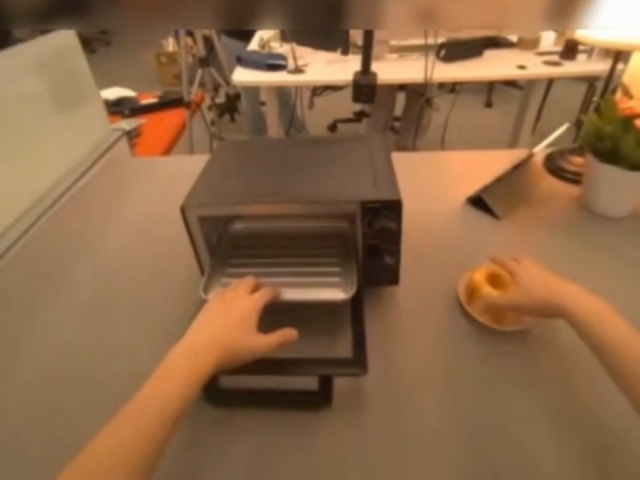
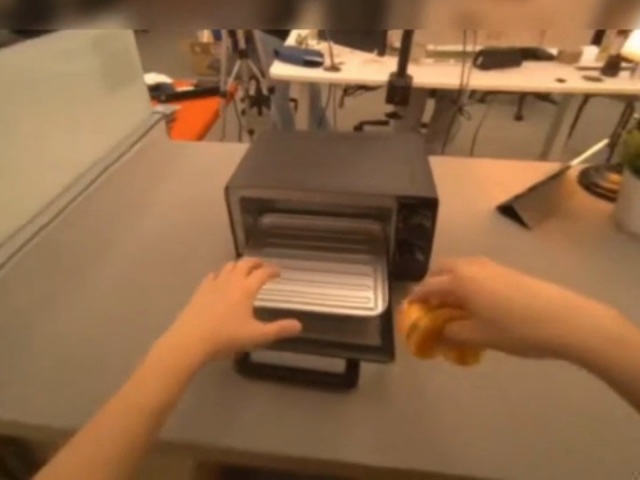
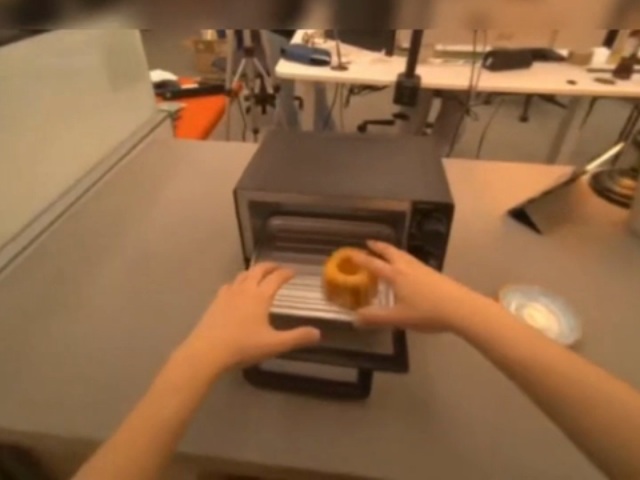
“Move the bread toward the open oven.”
Left handRight hand
1 New York University
* Equal contribution
Introducing Steertuning, a method that combines finetuning with action steering at deployment, enabling a policy to adapt to a new task in a new environment with 5 human demonstrations in under 5 minutes.
4× speed
Two minutes to adapt
Reuse a demo to guide actions
4× speed
Current recipes for robot learning require massive amounts of robot demonstrations to obtain robust and adaptive policies. In this work, we introduce Steertuning, a system that enables robots to learn new tasks in new environments from 5 human demonstrations in under 5 minutes.
Steertuning consists of two parts. (1) We pretrain a 400M-parameter diffusion policy on our egocentric human dataset, which consists of 100 hours of densely annotated random interactions. This pretraining makes Steertuning robust to background differences and enables spatial and object generalization when deployed on new tasks. (2) Given 5 demonstrations of a new task, we finetune our model for only 2 minutes (2000 training updates) and steer the policy’s actions during reverse sampling using the demonstration whose observation is closest to that of the deployment environment. Together with a carefully designed data processing pipeline for embodiment transfer, this enables Steertuning to achieve a 71% success rate across 12 tasks in 12 new environments, ranging from lab settings to kitchens in new homes. The entire process, from data collection for a new task to robot policy deployment, takes less than 5 minutes. Our full dataset, model weights, codebase, and robot videos will be made available at https://steertuning.github.io.
“Move the bread toward the open oven.”
Generate a mask for the object.
Remove hands and arms.
Align and sample 5,000 scene points.
Frozen base
At deployment, the finetuned policy generates actions for the current scene, guided by a matched human trajectory during denoising.
Loading the recorded hand poses…
We ablate finetuning, steering strength, and trajectory selection to evaluate their roles in adaptation.
Prediction error on 12 tasks · approximate values
We use Gemini ER 1.6 to orchestrate navigation and manipulation, coordinating the robot’s actions to complete the task.
Pick up the bag and bring it to the table.
Gemini ER 1.6
The base approaches and settles in front of the bag before the hands begin the pickup.
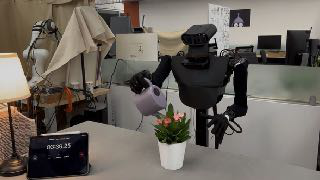
71% success across 12 tasks in new environments.
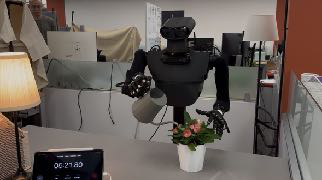
83% success on 3 lab tasks after 2 minutes of finetuning.
10 trials per lab task.
4× speed
Steertuning handles new object appearances when the required action remains similar.
 Original7/10
 Replacement6/10
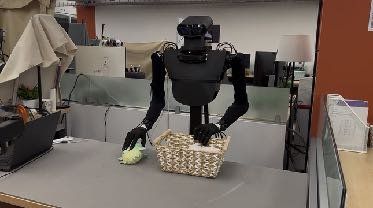 Original10/10
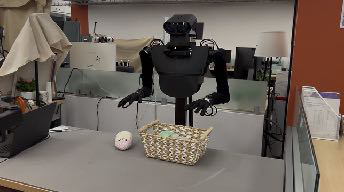 Replacement9/10
3 lab tasks · mean ±1 SD · green: ours
We thank Jeff Cui, Zifan Zhao, Dandan Shan, Bowen Tan, Andre Wang, Tianxing Zhou, Liangguang Zhou, Zicheng Teng, Lucas Liu, Sissi Hu, and Charles Ji for valuable discussions and feedback, and Mais Dwal, Kikki Liu, Jingyu Li, Melody Zuo, Kevin Tang, Ayaan Mustafa, Neytiri Cheng, Wilfendjy Mathurin, Maggie Wang, Cindy Ma, John Mwangi, Chloe Wang, Tasnim Raisa, Amelia Tang, and Bruce Zhang for their help with data collection.
This work was supported by grants from LG, Qualcomm, Honda, Microsoft, NSF award 2339096, ONR award N00014-22-1-2773 and Institute of Information & Communications Technology Planning & Evaluation (IITP) with a grant funded by the Ministry of Science and ICT (MSIT) of the Republic of Korea in connection with the Global AI Frontier Lab International Collaborative Research Agreement. (No. RS-2024-00469482 & RS-2024-00509279). Lerrel Pinto is supported by the Sloan, Packard, and CIFAR Fellowships.
Artificial intelligence (AI) tools were used to improve the grammar and clarity of this paper. AI was not used to generate any of the text or references.